Measure analysis of surface roughness
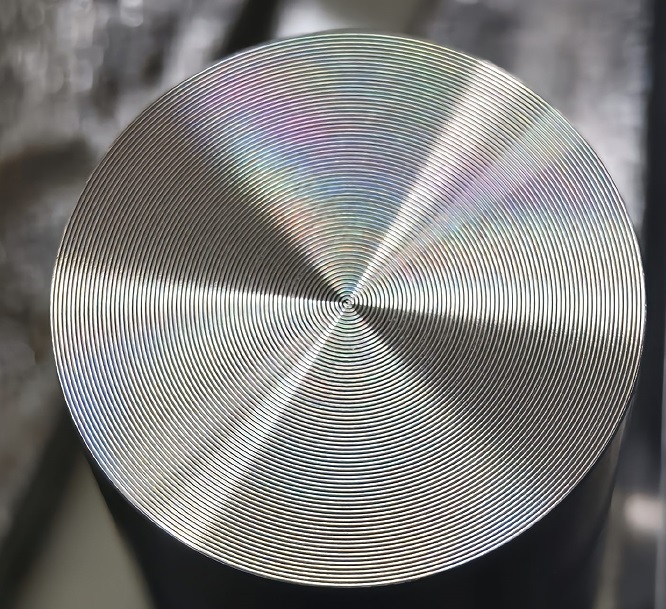


Aerospace products have extremely high requirements for weight, reliability, durability, and environmental adaptability.
Due to their superior material properties, titanium alloys are widely used in the aerospace industry.
Anodized coatings on titanium alloys can enhance a workpiece’s wear resistance, corrosion resistance, and resistance to atmospheric corrosion;
These coatings possess good electrical insulation properties and can serve as dielectric layers in capacitors;
They can also function as other specialized coatings, such as magnetic alloys deposited on porous membranes for use as memory elements, solar absorbers, ultra-hard coatings, dry lubricating coatings, and catalytic layers.
The color, thickness, and properties of the resulting titanium alloy anodized coatings vary depending on the electrochemical oxidation solution and process conditions.
Currently, the most commonly used method for titanium alloy anodizing in China is acidic anodizing, which employs a sulfuric acid solution.
While this method has low production costs and a simple process, it suffers from poor contamination resistance of the coating.
This study uses sulfuric acid as the raw material. We verify key process parameters including temperature, voltage and treatment time.
We propose a blue titanium alloy anodizing process scheme.
This scheme offers technical support for wider application of titanium alloy anodized coatings.
We investigate whether anodizing can produce a blue finish on titanium alloys.
Our analysis covers two parts. First, we study the coloring mechanism of titanium alloy anodized coatings.
Second, we validate relevant process parameters.
The charging of the double layer at the metal-electrolyte interface forms the anodic oxide coating on titanium and titanium alloys.
It primarily consists of two layers: the “substrate” and the “film.”
The “substrate” is the underlying titanium alloy base material, while the “film” is the newly formed, transparent titanium dioxide (TiO₂) film on top, which possesses a certain thickness and refractive index.
White light contains all wavelengths of visible light. It hits this film system.
Two optical processes take place. Some light reflects directly off the oxide film’s top surface.
This forms reflected light I1. Other light passes through the oxide film.
It reflects at the interface between the oxide film and titanium substrate. This forms reflected light I2.
These two reflected light beams (I1 and I2) are coherent (they have the same frequency, vibrate in the same direction, and have a constant phase difference).
When they meet again, interference occurs. The principle of light interference with the oxide film is shown in Figure 1.
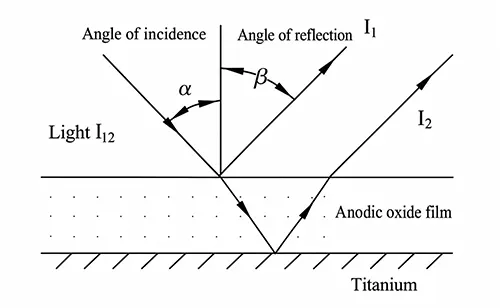
Interference between the reflected light I1 from the surface of the oxide film and the light I2 reflected at the interface between the transparent oxide film and the metal substrate produces various colors.
The path length difference (Δ) is the key factor causing the interference phenomenon, and its formula is:
Δ=2ndcos θ.
In this equation: n is the refractive index of the oxide film; d is the thickness of the oxide film;
We approximate θ as the angle of refraction (we can typically approximate it as 0°, so cos θ ≈ 1).
Therefore, the thickness of the oxide film primarily determines the final color.
Depending on the thickness of the oxide layer, the titanium surface can exhibit a variety of colors, including yellow, green, gold, purple, and blue.
In a specific electrolyte, the process parameters that affect the thickness of the oxide layer include voltage, processing time, and bath temperature.
Theoretical studies have shown that by controlling process parameters such as voltage, it is possible to produce a blue oxide layer on titanium alloys.
Titanium Alloy Anodizing Process Flow: Pre-shift preparation → Inspection → Chemical degreasing → Hot water rinse → Cold water rinse → Water film continuity check → Clamping → Sulfuric acid anodizing (immersion while energized) → Cold water rinse → Unclamping → Air drying → Oven drying → Packaging → Inspection.
Process parameters affecting film thickness include voltage, processing time, and bath temperature.
We maintain constant electrolyte concentration in the solution.
We vary only bath temperature, voltage and time.
This method generates blue titanium alloy oxide films meeting product specifications.
The electrolyte currently used for titanium alloy anodizing is sulfuric acid, and the process parameters are shown in Table 1.
The surface condition of the titanium alloy specimens after anodizing is shown in Figure 2.
| Alloy Number | Electrolyte Concentration (ρ(H2SO4) = 1.84 g/mL)/(g/L) | Bath Temperature (°C) | Voltage (V) | Oxidation Time (min) |
|---|---|---|---|---|
| A77, A78, A79 | 150–300 | 19 | 17 | 4 |
Table 1. Anodizing Process Parameters for Titanium Alloys
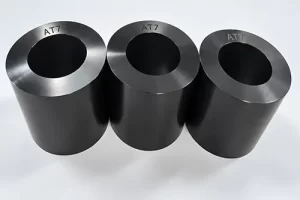
We held voltage and time parameters constant, setting the voltage to 17 V and conducting anodization at temperatures of 30 °C and 35 °C, to investigate how different electrolyte solution temperatures affect the membrane layer condition.
Table 2 lists the specific process parameters, and Figures 3 to 10 show the membrane layer color.
| Alloy Number | Bath Temperature (°C) | Voltage (V) | Oxidation Time (min) | Film Thickness (μm) | Color | Remarks |
|---|---|---|---|---|---|---|
| A28 | 11 | 17 | 4 | 1.7–1.9 | Yellowish brown | Figure 3 |
| A68 | 13 | 17 | 4 | 1.3–1.9 | Yellowish brown | Figure 4 |
| A59 | 15 | 17 | 4 | 1.7–2.1 | Yellowish brown | Figure 5 |
| A88 | 17 | 17 | 4 | 1.1–1.4 | Yellowish brown | Figure 6 |
| A88 | 21 | 17 | 4 | 0.8–1.5 | Purple | Figure 7 |
| A59 | 25 | 17 | 4 | 0.8–1.2 | Purple | Figure 8 |
| A68 | 30 | 17 | 4 | 1.1–1.2 | Purple | Figure 9 |
| A28 | 35 | 17 | 4 | 1.2–1.3 | Purple | Figure 10 |
Table 2. Effect of Bath Temperature on Oxide Film Characteristics at 17 V
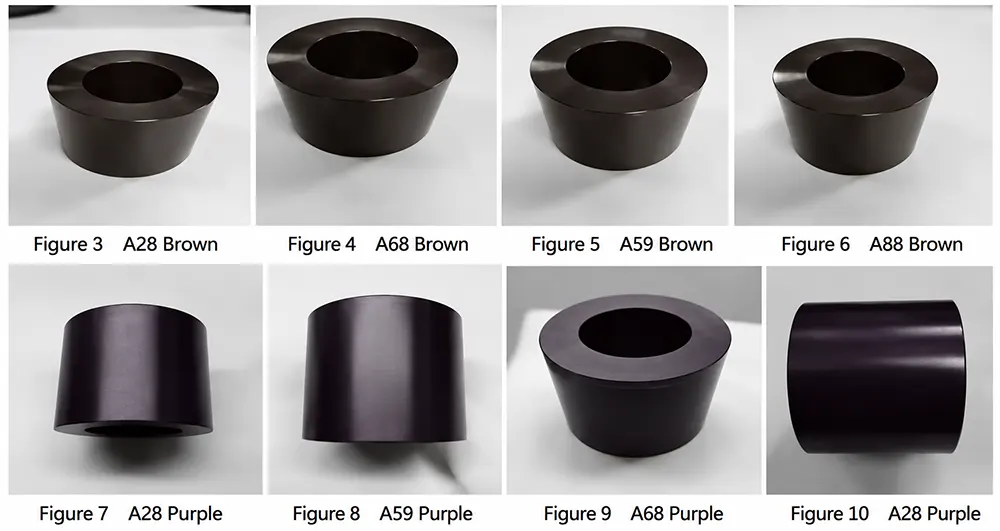
Experimental data show that, with the voltage (17 V) and oxidation time (4 min) held constant, the film color was yellowish-brown at 11 °C, 13 °C, 15 °C, and 17 °C, and purple at 21 °C, 25 °C, 30 °C, and 35 °C.
We held voltage and time parameters constant at 21 V and 4 min respectively, and verified how different bath temperatures (11 °C, 13 °C, 15 °C, 17 °C, 21 °C, 25 °C, 30 °C, and 35 °C) affect the film’s state.
Table 3 lists the specific process parameters, and Figures 11–18 show the film’s color.
| Alloy No. | Electrolyte Temperature (°C) | Voltage (V) | Anodizing Time (min) | Film Thickness (μm) | Color | Remarks |
|---|---|---|---|---|---|---|
| A1 | 11 | 21 | 4 | 0.9–1.5 | Violet-Blue | Figure 11 |
| A62 | 13 | 21 | 4 | 2.1–3.3 | Violet-Blue | Figure 12 |
| A45 | 15 | 21 | 4 | 2.2–2.8 | Violet-Blue | Figure 13 |
| A46 | 17 | 21 | 4 | 1.5–2.4 | Violet-Blue | Figure 14 |
| A46 | 21 | 21 | 4 | 1.2–1.4 | Light Blue | Figure 15 |
| A45 | 25 | 21 | 4 | 1.2–1.6 | Light Blue | Figure 16 |
| A62 | 30 | 21 | 4 | 1.1–1.3 | Light Blue | Figure 17 |
| A1 | 35 | 21 | 4 | 1.3–1.4 | Light Blue | Figure 18 |
Table 3. Effect of Electrolyte Temperature on Anodized Film Properties at 21 V
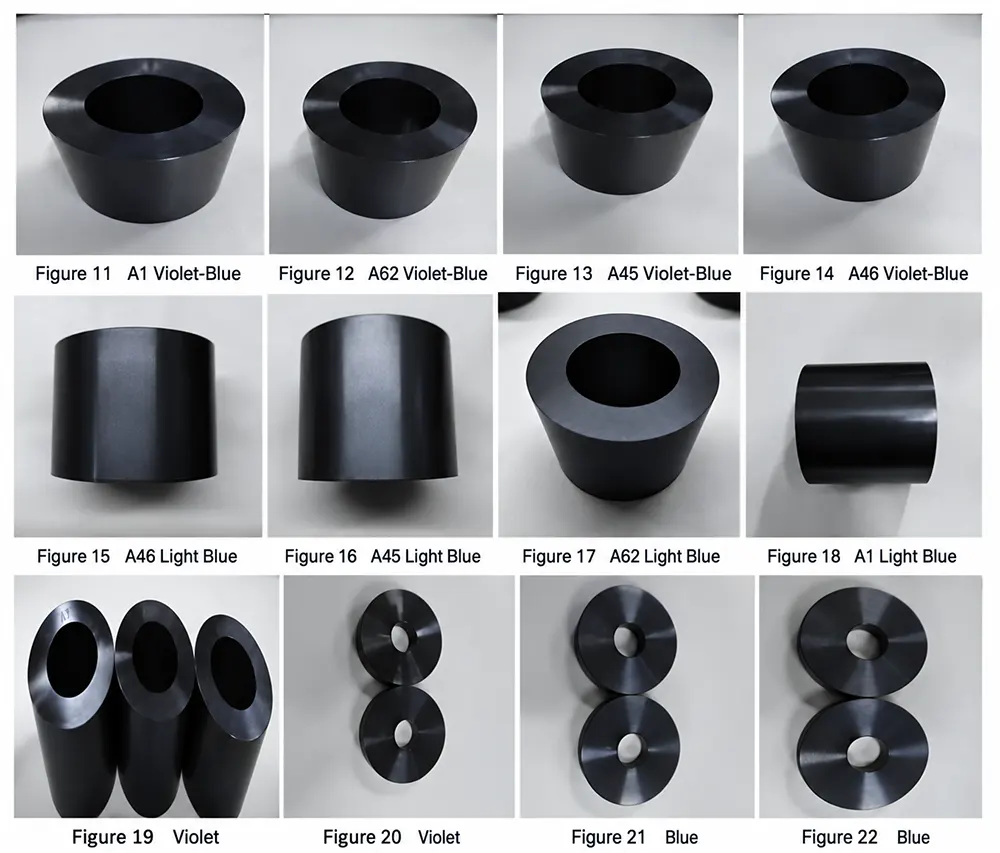
Experimental data show that, with the voltage (21 V) and oxidation time (4 min) held constant, the coating color was violet-blue at 11 °C, 13 °C, 15 °C, and 17 °C, and light blue at 21 °C, 25 °C, 30 °C, and 35 °C.
The coating thickness increased as the voltage rose.
The research results indicate that different temperatures have a minimal effect on the appearance of the coating, while voltage is the key process parameter influencing color changes.
To ensure the stability of the bath solution, the bath temperature remains unchanged;
Thus, the process parameter for the titanium alloy anodizing (blue) bath temperature remains at 19 °C.
We set the bath temperature to 19 °C and verified how different voltages and oxidation times affect the film’s thickness and color.
Figures 19–22 show the film’s color changes, and Table 4 lists the process validation parameters.
Experimental data show that when the bath temperature is set to 19 °C, the oxidation color changes from purple to blue as the voltage increases.
At the same voltage, extending the oxidation time results in little change in color.
This is because the titanium alloy oxide film forms primarily during the initial stage of electrolysis, and the film thickness depends on the voltage; the higher the voltage, the thicker the resulting oxide film.
Therefore, voltage is the key factor affecting the appearance of the oxide film.
The research results indicate that as the voltage increases from 17 V to 23 V, the film color changes from purple to blue.
Extending the oxidation time does not result in any significant change in surface appearance;
Therefore, the process parameter for titanium alloy anodization (blue) is set at 4 min.
Electrolyte Temperature (°C) | Voltage (V) | Anodizing Time (min) | Film Thickness (μm) | Color | Remarks |
|---|---|---|---|---|---|
19 | 17 | 4 | 0.7–0.9 | Violet | Figure 19 |
19 | 17 | 8 | 0.7–0.9 | Violet | Figure 20 |
19 | 23 | 4 | 1.1–1.4 | Blue | Figure 21 |
19 | 23 | 8 | 1.1–1.4 | Blue | Figure 22 |
Table 4. Effects of Different Voltages and Anodizing Times on Anodized Film Properties
We summarize the process validation results for blue titanium alloy anodizing as follows:
1) Process Flow: Pre-shift preparation → Inspection → Chemical degreasing → Hot water rinse → Cold water rinse → Water film continuity check → Clamping → Sulfuric acid anodizing (immersion while energized) → Cold water rinse → Unclamping → Air drying → Oven drying → Packaging → Inspection.
2) Process Parameters: Mass concentration of electrolyte (prepared from H₂SO₄ with a density of 1.84 g/mL) 150–300 g/L; bath temperature 19 °C; voltage 23 V; oxidation time 4 min.
We performed a neutral salt spray test on blue anodized titanium alloy specimens made with this process following GJB150.11—1986 Environmental Test Methods for Military Equipment—Salt Spray Test.
We observed no corrosion spots on the coating after 96 hours.
This process meets the product’s operational requirements.
The blue anodized coating on titanium alloys possesses high hardness, low friction coefficient, excellent wear resistance, and superior corrosion resistance.
Its distinctive blue hue provides a unique visual identifier for titanium alloy parts.
Workers operate in complex aircraft assembly environments. They can quickly tell blue titanium alloy parts apart from other components.
These other parts include uncoated stainless steel, cadmium-plated or phosphated alloy steel, and anodized aluminum alloy.
This capability effectively avoids wrong assembly. It raises assembly efficiency and accuracy.
1) Through research on the coloring mechanism of anodized coatings on titanium alloys, a set of viable process parameters was validated to achieve a blue anodized coating on titanium alloys.
2) The following optimal process parameters for the blue anodization of titanium alloys were identified: electrolyte mass concentration (prepared using H₂SO₄ with a density of 1.84 g/mL) of 150–300 g/L, bath temperature 19 °C, voltage 23 V, and anodizing time 4 min.
3) The color range of sulfuric acid-based titanium alloy anodized coatings has been expanded from purple to blue.
The resulting blue titanium alloy anodized coatings are continuous, uniform, and smooth, exhibit excellent corrosion resistance, and have a wide range of applications.